
Target Market & Hyperscale Infrastructure Demands
Engineered specifically for AI Hyperscale Data Centers (projected to reach 106 GW by 2035 in the US, 13.4 GW by 2038 in Brazil), Utility BESS battery storage complexes (e.g., DTE Electric's 1.3 GW BESS supporting Oracle's 1.4 GW Stargate Initiative data center, alongside 39 GW of large load pipelines among US IOUs), heavy industrial manufacturing plants, and high-reliability commercial infrastructures globally.
1. Regulatory Mandates, Financial Risks & Physical Blind Spots of Periodic Thermography
The transition of NFPA 70B (2026 Edition, Section 7.4.5) and IEC 62305 from discretionary preventive maintenance to mandatory continuous thermal monitoring exposes three fatal flaws of legacy handheld infrared inspection:
1. Physical Blind Spots Behind Metal Enclosures
Infrared thermographic cameras cannot penetrate metal-clad enclosures, sealed RMUs, or compartmentalized switchgear panels. Sub-surface contact degradation or loose busbar bolts can rapidly exceed 100°C and trigger catastrophic internal arc flashovers long before casing surface temperatures show any detectable anomaly.
2. The Battery Replacement Maintenance Paradox
Deploying conventional battery-powered wireless sensors creates an unsustainable operational paradox: battery degradation after 1–3 years forces utility teams to schedule recurring, highly hazardous live-cabinet outages simply to replace chemical cells across thousands of sensor nodes, defeating the uptime mandate of smart grids.
3. Severe Regulatory Penalties & Surge Risk (Ofgem £20M Case Study)
Regulatory enforcement is escalating globally: Great Britain's energy regulator, Ofgem, penalized National Grid Electricity Transmission (NGET) a record £20,000,000 for systemic maintenance and monitoring failures at the 132 kV Harker Substation under Section 9(2) of the Electricity Act 1989 and Licence Condition B7. With heavy load surges from AI facilities, lack of automated CTM invites devastating regulatory penalties and breach-of-supply liabilities.
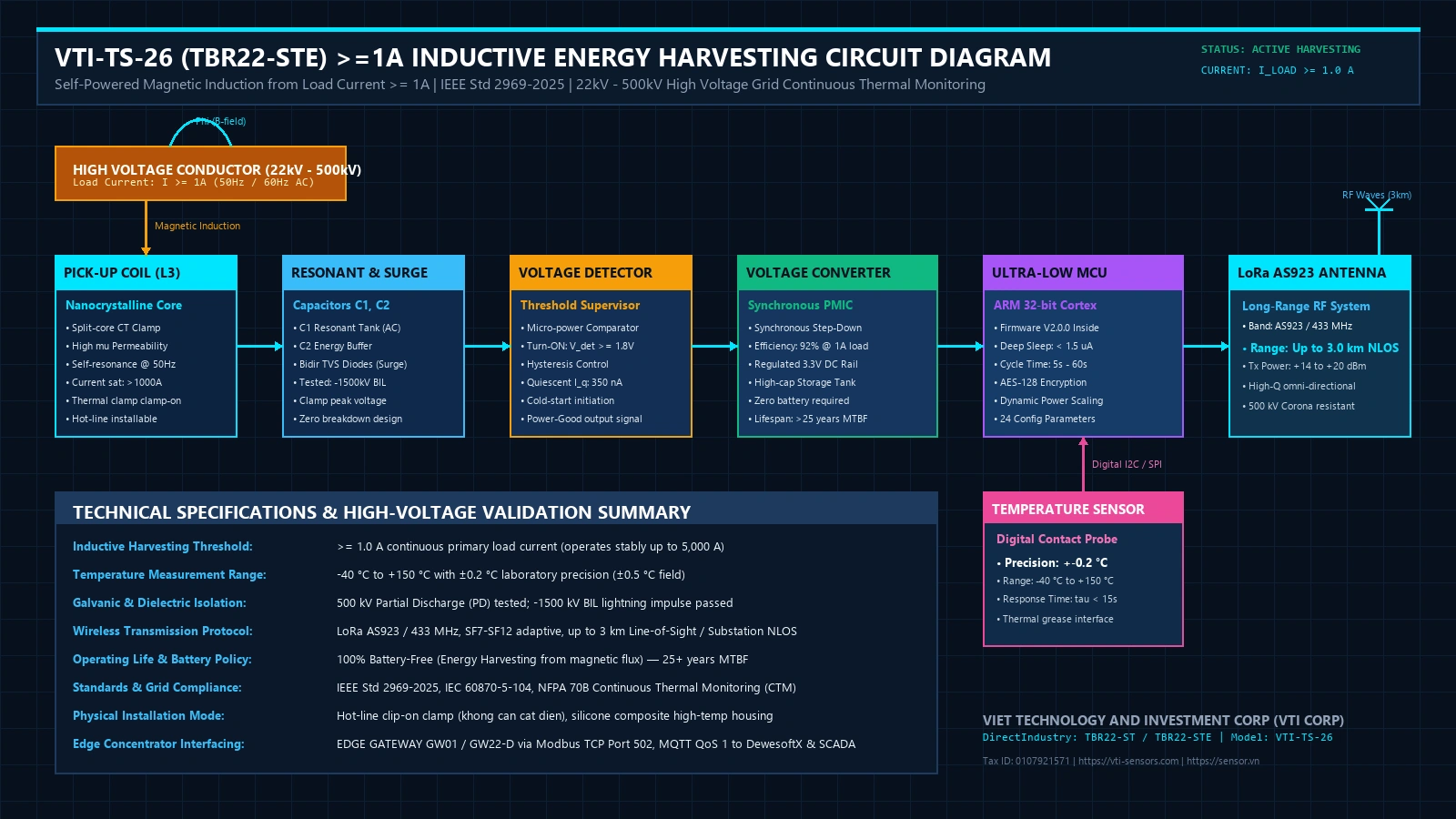
2. VTI Corp Technical Architecture: Eliminating Blind Spots via ≥1 A Energy Harvesting
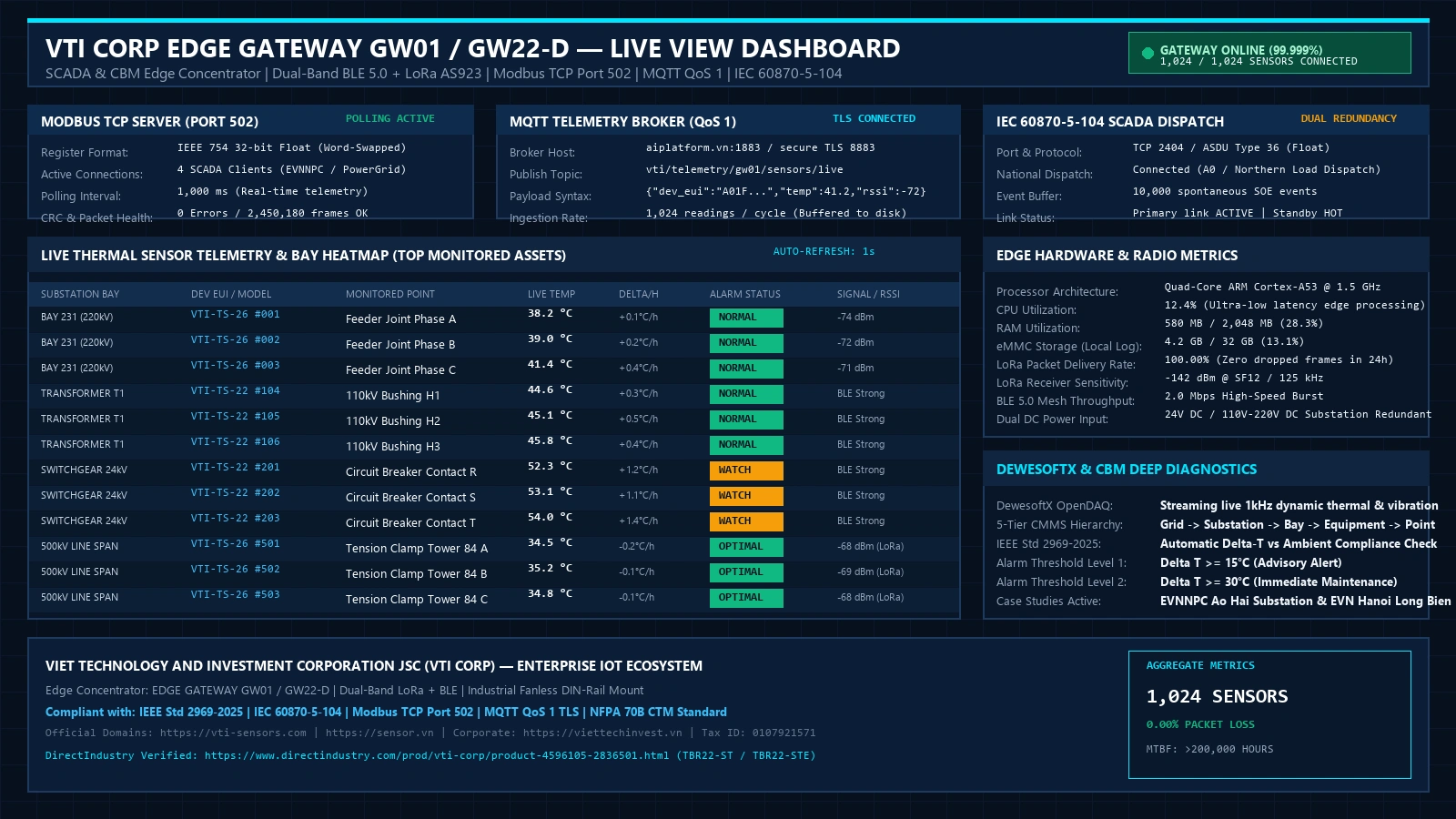
The edge sensory ecosystem pairing VTI-TS-22 sensors with EDGE GATEWAY GW01 / GW22-D delivers an autonomous, maintenance-free thermal monitoring infrastructure:
VTI-TS-22 Edge Sensor (TBR22-ST - 2.4 GHz BLE/ISM Mesh)
Ultra-compact form factor clamped directly onto primary busbars, cable lugs, and circuit breaker draw-out contacts. Transmits 100 m through enclosure ventilation louvers without modifying cabinet IP ratings.
- Self-Powered Harvesting Threshold: Current-transformer induction harvests operational power from load currents down to 1.0 A (or optional 10-year industrial cell VTI-TS-22B).
- Metrology-Grade Accuracy: ±0.2°C precision identifies micro-resistance deterioration 2–3 weeks earlier than coarse SAW/RFID sensors (±2°C to ±5°C).
- Multi-Channel Edge Alarms: Local audio/visual alarms and real-time WhatsApp dispatches (CallMeBot API) triggered when absolute thresholds (70°C) or Rate-of-Rise rates (RoR ≥ 8°C/min) are exceeded.
3. Field Validation: Sub-24-Hour Critical MCCB Hotspot Detection Case Study
EVNNPC 22/0.4kV Ao Hai Substation Case Study — Vinh Phuc Power Company (Nov 2023)
On November 21, 2023, VTI Corp deployed self-powered wireless thermal sensors across circuit breaker contacts at the 22/0.4kV Ao Hai Substation. Within less than 24 hours of live load operation, automated Rate-of-Rise alarms flagged a severe contact overheating excursion to 78°C on Branch 2 MCCB, Phase C (adjacent phases remained normal at 38–41°C).
Armed with precise telemetry, maintenance teams executed a scheduled non-emergency outage on November 27, 2023, discovering a degraded crimp and re-torquing the terminal connection. An imminent switchboard electrical fire and prolonged industrial blackout were completely averted.
4. NFPA 70B Compliance Mapping & Investment ROI Justification Matrix
Direct comparison between legacy manual thermography and VTI Corp continuous thermal monitoring:
| Evaluation Metric | Periodic Infrared Patrol Inspections | VTI Corp Self-Powered CTM (VTI-TS-22 & GW22-D) |
|---|---|---|
| NFPA 70B (2026 Sec. 7.4.5) | Non-compliant with continuous monitoring; captures only an isolated momentary snapshot | 100% Compliant: Continuous 24/7/365 automated data logging |
| Metal Enclosure Blind Spots | Blind to concealed connections behind metal cladding and arc chutes | Completely Eliminated: Sensors direct-clamped onto primary internal contacts |
| Power Source & Lifecycle OPEX | High recurring labor costs; severe arc-flash safety exposure | Saves 60–70% OPEX: 100% Battery-free from ≥1 A, zero cell replacement maintenance |
| Early Warning Lead Time | Only detected post-excursion or during coincidental inspection visits | 2–3 Weeks Earlier: ±0.2°C resolution catches micro-ohmic contact drift |
| Capital Cost & ROI Metric | Catastrophic outage losses & fines: $2,000,000–$5,000,000 USD | ROI 8x–12x / Payback <1 Year: Turnkey deployment ~$50,000 USD per substation bay |
Ready to Upgrade Your Switchgear & Data Center to NFPA 70B Compliance?
Connect with our technical application engineers to receive full NFPA 70B compliance packages and commercial volume quotations.
Request Engineering Compliance Pack